WHAT MY CAT IS READING

chronicles of what books I've bought, what books I've read and other things.
specific other things will be pictures of my cat and especially cute outfits I come up with.
Showing posts with label YA. Show all posts

Sunday, June 20, 2010

A duet of series.

I'm really not kidding when I say I read a lot of YA fiction. My last two literary accomplishments are reading through the first three Anne books by Lucy Maud Montgomery and finishing the Percy Jackson and the Olympians series by Rick Riordan.

I first read Montgomery's Anne books when I was in elementary school, around fifth or sixth grade. I didn't remember too much from the series, except for vague images of red headed girls running around in forests and a dashing man with an umbrella. Re-reading Anne of Green Gables, Anne of Avonlea and Anne of the Island did not disappoint and in fact brought these images back into clear focus. The first book is definitely my favorite, because of Anne's extreme excitability, her amusing rants and joyous outlook on life. I loved most of all her interactions with Gilbert Blythe, from smashing her slate over his head when he called her "Carrots" to his rescue of her when she's stranded in a river. Her stubborn streak is a few miles wide and it's amazingly endearing. During these young years, Anne is at the peak of her dramatic nature and it never fails to be amusing to hear her wail about how her life is ruined by the lack of puffy sleeves, or not being able to go to a picnic, or accidentally getting her friend drunk, and so on and so on.

Accordingly, Island is my least favorite of the three: by this time in Montgomery's series, her heroine is becoming a little too perfect to make for enjoyable reading. While Avonlea mostly follows Anne's quiet few years as she teaches school, Island finds her going away for college and, lo!, she immediately becomes best friends with the most popular girl on campus, has dozens of men interested in her, finds a lovely house to rent that no one else seemed able to get, is awarded all the scholarships she could dream of... By this point, Anne's looking like she should be called Mary Sue instead (hey, at least there's still an 'e' at the end of the name!).

The high point in these later novels, though, is still Gilbert Blythe. He is the perfect young man throughout the novels -- well, excepting the minor tortures evidenced in the first book -- and is constantly charming and interesting. He's attractive, intelligent and confident. Sure, at times his infatuation with Anne seems a bit far-fetched, but he knows what he wants and is willing to fight for it. But, nevertheless, he won't let himself be pushed around: the man's got backbone and it makes a girl wonder just what other sorts of bones he's hiding, if I can get a little crude.

I decided to stop reading Montgomery's books at the end of Island because, well, now that Gilbert and Anne are engaged, what more is there to know? I read further on in the series when I was younger, but the household drama wasn't quite as interesting and so I feel pretty secure in putting my acquaintance with Avonlea on hold for now.

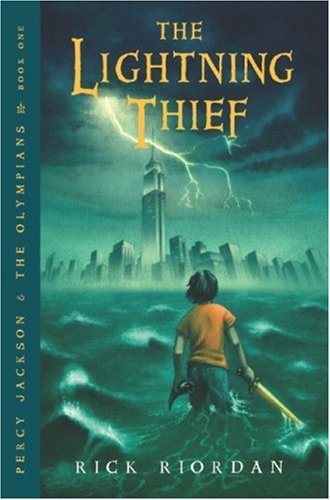
The other series I've been plodding through for a while now is Rick Riordan's Percy Jackson quintet. I listened to the first two books on tape, which naturally takes about three times as long as reading a book oneself, and was very pleasantly surprised by how intricate and involved the world Riordan created was. And now that I've finished the whole series, I'm still infatuated.

The series follows Percy in his adventures fighting monsters alongside half-bloods, other children like himself who are half-human and half-God. Percy himself boasts of Poseidon, the sea god, as a father. A prophecy lurks over the entire series and the world becomes slowly more and more in jeopardy as Kronos, the Titan father of most of the Olympians, regains power and control. The last book culminates in a massive battle between the half-bloods and the Titan's army.

But it's not only battle and adventure that spurs these books on: there's also intriguing characters, a few plausible and adorable romances, and, most interestingly in my opinion, a lot of subtle teaching about Greek myths. Anyone who reads these books suddenly can name all the major Greek gods, knows a ridiculous amount about various Grecian monsters, and might even have picked up a little bit of the Greek language.

While Riordan's general plot and character tropes might mirror that of the Harry Potter books, I don't think this is any sort of detraction for his series. Instead, it just means that young adults who enjoyed Rowling's books can now enjoy a series with a little bit of added punch and, perhaps, familiarity, as Riordan's books are set in the United States. Riordan himself even admitted to taking some inspiration from the Harry Potter books, when he wondered why there weren't any adventure books like that for kids like his son: kids with ADD or dyslexia. Percy Jackson, it turns out, has both, like most half-bloods do (the ADD is linked to their natural battle instincts, while less believably the dyslexia is because their brains are hardwired for ancient Greek).

(I do have to say, though, that the movie isn't half as good as the books. In fact, I only made it through the first half of the movie before I was disappointed and upset. I strongly suggest the books over the movie.)

Montgomery's Anne books are charming and fun, quick reads, but definitely more targeted toward a young female population. They provide an easy blast to the past, set in eastern Canada during the early twentieth century. The Percy Jackson novels, on the other hand, provide an adventure in our modern time, while introducing readers of all shapes, sizes, ages and genders to the idea of courage and pride, of sticking to your friends and believing in family. If I had to choose between these series, I would definitely vote for Rick Riordan over Lucy Maud Montgomery, but that doesn't mean Anne isn't quite as much of a character as Percy. Let's just hope they never meet.

Monday, May 31, 2010

Apologies and books.

It turns out taking a trip to South America, planning to move across country, and all the other little things thrown at a girl during her life can sometimes lead to her forgetting to update her blog. Or, of course, remembering at very inopportune times.

In the last two months, I've read quite a few books, but I'm afraid I can only right now remember four of them: We Need to Talk About Kevin by Lionel Shriver, Nightmares and Dreamscapes by Stephen King, 1984 by George Orwell, and, finished today, So Yesterday by Scott Westerfeld. Because half of these books were sadly read some time ago, I'm going to keep my discussion of each of them limited and, instead, promise to do better next time.

As I mentioned, I took a trip to South America in the middle of April; I went to Peru and spent a few days in a very small village and helped repair destruction from an earthquake three years ago. In packing, I somehow got the idea in my head that I'd have plenty of free time, so I brought three books and, of course, only managed to get partway through one of them. That one was Kevin by Lionel Shriver. An epistolary novel, this book records letters written by a woman to her estranged husband a few years after their son, Kevin, kills a dozen people one day at his school. It's a harrowing read, if I can use that cliche term, and extremely emotional. Whenever I picked the book up, I had a hard time setting it down but, I admit, once I did, it was three or four days before I set to reading it again. It was a hard read at times because of the honest realism of the woman's struggle to be a loving mother and figure out how to react to the horror that was her son's life. So far, I think this book might be one of my favorites of the year.

Nightmares and Dreamscapes took a while for me to get through, as well, but not because it was difficult or too emotional: it's just a large book. A collection of King's stories, I read these during my lunch breaks at work and, in fact, received some gentle ridicule for that. My boss joked that it seemed even I needed some light "beach" reading once in a while, and while I laughed and agreed with him at the time, I've since decided that even King's short stories aren't necessarily light reading. Images of a lone, stray eye pulling itself out of a drain, of a woman stalked by her late husband turned zombie, of towns that suck you in and never let you leave... Perhaps King hadn't created a literary masterpiece, but he's certainly a master of horror, even when locked into only a few pages. His timing is perfect and his imagery stunning. This isn't my favorite work of his, but that certainly doesn't mean it's not worth while.

There's a few books I like to read every year or two to see what themes and images stick out to me this time. Ender's Game is one, To Kill a Mockingbird another. And one that constantly calls out to me is Orwell's 1984. I first read this book my freshman year of college, just for fun and in order to start filling out my literary canon knowledge. Now it's become one of my regular reads; as soon as it's been long enough for me to start to forget what it's about, I pick it up and am yet again amazed. This time it was the torture scenes nearing the end of the book that chilled me the most. O'Brien's cool and collected personality in the face of the horrendous acts being done to Winston... And most of all, Room 101. Perhaps I had blocked Room 101 out of my memory from when I last read it, but the horrors there shook me anew and I had a hard time continuing. I love this book (cue gunshot to the head).

I had the house to myself this Memorial Day weekend, and while others might use that opportunity to host a few wild parties, my first instinct was to stock up on books and use the solitude to my best advantage. Unfortunately, as I get older and have more responsibilities, I can no longer devour books the way I did when I was young, so I only got through one book (so far!): So Yesterday by Scott Westerfeld. A young adult book, I'm a somewhat fan of Westerfeld's novels. His Uglies trilogy started out strong and interesting but lost me halfway through the second book. (Then again, I did read all three, so that might say something for Westerfeld after all..)

Like a lot of Westerfeld's works, So Yesterday takes ideas common to the youth of today and adds a little twist. What if all the fads and hip ideas coming down the grapevine were actually controlled, hunted out, and specifically targeted at different demographics? That doesn't sound too strange: it's what PR firms do every day. But what if kids known as "cool hunters" were a part of that? This story follows one of those cool hunters as he gets involved with an "Innovator" (one of those rare people who make up something cool all on their own and then shortly see it everywhere from Youtube to the six o'clock news); the duo shortly realize that maybe not everything about forced consumerism is working as well as it should.

While definitely a fun, interesting and at times easily philosophical novel, unfortunately So Yesterday sometimes reads ... well, a little yesterday. The amazing technology described by the narrator is a little dated (his phone can take ten whole seconds of video!) and the idea that a seventeen year old has a full time job running around NYC looking for cool things might be a little unapproachable. Nevertheless, Westerfeld does a good job of making his characters realistic despite their unreal surroundings. This book fits nicely into our modern culture obsessed with fashion, celebrities and technology and provides a slightly off way of looking at life. Recommended!

Saturday, February 6, 2010

The Second Civil War


I mentioned it before: the book club I was a part of during junior high and high school. Every first Wednesday of the month during the school year and every Wednesday during the summer, I'd trek down to the local library and enjoy an hour and a half of nerdy talk with other literary-minded teenagers and the teen librarian who put up with us. This experience, I believe, is the real reason behind my continued love affair with young adult literature. YA books can be just as smart and intriguing as those shelved in the adult fiction areas and are often more approachable. In my work with high schoolers at my church, too, it can sometimes be valuable to be familiar with new YA literature.

I just finished reading, for a second time, one of my new favorite YA books: Unwind by Neal Shusterman. Science fiction at its finest, Shusterman tackles the incredibly tense topic of abortion and human rights. Set fifty years or so after the second Americal civil war, known in the story as the Heartland War, Shusterman's created a world where abortion is illegal, but alternatives have been made common: unwinding and storking. Storking is the more mundane of the birth control issues presented in the novel; it's basically where a newborn baby is left on the doorstep of a house by a mother who cannot or will not take care of it. If a family is "storked," they are automatically the legal guardians of the child and have to simply deal with it.

Being unwound... that's a tougher issue. While the image of the book here is the copy that I own, this cover art more terrifyingly portrays the truth of the issue. Unwinding is organ harvesting and donation taken to the extreme. Thanks to a technology called 'neurografting,' in the world of Unwind, every part of a body can be safely transplanted and used. That was how the Heartland War was settled: both pro-life and pro-choice sides were pleased, since parents could choose to have their children unwound, but according to the technology, the child was never actually killed, as each part of their body was kept alive through the surgery.

The story follows three young adults who have been selected to be unwound: Connor, whose parents decided they'd rather have their eldest son be divided than remain in their house as the troublemaker he was; Risa, a ward of the state who was the victim of budget cuts; and Lev, a child specifically born and raised to be a "tithe," meant from birth to be unwound.

Shusterman's portrayal of this issue is masterful, touching and at times frankly horrific. One of the most impressive parts of his novel is how it remains roughly unbiased in terms of the pro-life and pro-choice struggle even now making its way through America. At one point in the novel, thinking of the babies deposited at places like the state homes she herself grew up in, Risa wonders which was worse: "To have tens of thousands of babies that no one wanted, or to silently make them go away before they were even born? On different days Risa had different answers." Connor recalls a time his family was storked and, not having the finances to take in another child, illegally passed the child onto the next house on their block, only to be re-storked a week and a half later -- with the same baby who by that time was jaundiced and soon died.

There's no question in the novel that unwinding was the worst compromise ever considered by those who fought the Heartland War, and that storking more often than not ended in misery. Shusterman presents these possible futures with a sense of foreboding and warning, but the novel rarely dips into something of a preachy tone. Even in a scene where four boys discuss the existence of a soul and when life starts (all the common current perspectives are introduced and each given their due weight, each with counterpoints and facts to back them up), it's just in a way to encourage the young readers who picked up the novel to start to think on the issues themselves.

Connor, Risa and Lev are unmistakably real, and that's what makes Shusterman's novel such a horror. Like every good foray into science fiction, this reality seems possible and like it's waiting just around the corner. But considering how well Shusterman presented the issue and how he delved into all possible sides throughout the story, it makes me hopeful that the young people reading this and other YA novels might, as they go into that cliched role of being our future, help make sure it never happens.