WHAT MY CAT IS READING

chronicles of what books I've bought, what books I've read and other things.
specific other things will be pictures of my cat and especially cute outfits I come up with.

Monday, April 5, 2010

Accidents happen

The past two months (two months since I last updated!) have been filled with trips, stress and news both good, bad and great. Amidst all that, I've found time to start four books but I've only managed to finish one.

I went to Peru for nine days near the end of March and brought with me three books. I only read one, but I didn't even manage to finish that. I was definitely optimistic in terms of free time or at least empty time when, instead, most of my trip was taken up with being sick or working myself ridiculously hard.
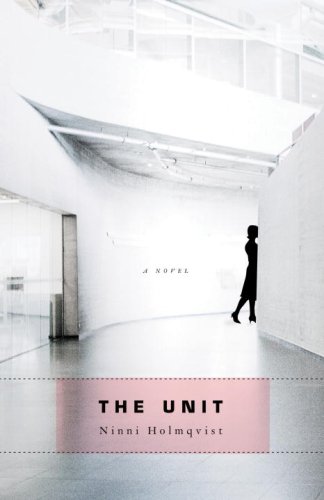


Nevertheless, I did finally manage to finish a book this week: The Unit by Ninni Holmqvist, translated from the Swedish by Marlaine Delargy. (I love good translators. While I couldn't read the original Swedish and so I can't say for certain how good of a job Ms. Delargy did, I completely forgot it was translated until the very end when I looked over the first few pages.

My mom recommended this book to me after reading my earlier entry on Unwind; she herself hasn't read The Unit yet, but it was recommended to her at an earlier date and she remembered it. I was more than happy to continue in the thread of dystopias examining the issue of the human body and, boy, I was not disappointed.

The Unit reminded me most strongly of Margaret Atwood's The Handmaid's Tale, as both look at a theme of what happens when the state decides our bodies aren't necessarily ours for one reason or another. In Atwood's tale, women are assigned roles in society based on their ability to conceive; Holmqvist targets both men and women in her novel, creating the label of 'dispensable,' which applies to any woman over the age of fifty and any man over the age of sixty-five who have no children and are not exceptionally successful in their career. Once a person is marked as dispensable, they are shipped off to a unit where they live communally with other dispensables and are routinely used in humane experiments and, eventually, for organ donation.

While Atwood focuses, then, on women's bodies being taken away from them, Holmqvist is able to examine a wider angle, despite her protagonist being a woman. In this world, it is not gender that sets the wanted apart from the useless: it is age and ability. Types of work are categorized: most of the dispensables, it's noted, are creative sorts who, yes, might have written a marvelous novel or painted a fantastic work of art, but they are not contributing to society in any directly calculable way and, so, can be set aside.

It was the mood of Holmqvist's novel that struck me the most, especially in connection to Atwood and Neal Shusterman's Unwind. Both Atwood and Shusterman filled their novels with the quick pace of fugitives or people actively working to get out of their situation. Holmqvist's protagonist, though, spends most of the novel simply floats through her situation, accepting what's given her. I don't mean to imply that the novel loses any sense of motion or that it drags: instead, the soothing nature of the unit, meant to lull its inhabitants into a sense of compliance, even works on the reader. It's easy to fall into the same traps as the characters and start to become convinced that the scenario presented in Holmqvist's dystopia really is the ideal. Atwood and Shusterman never quite reached that level of meta influence, for better or for worse.

Despite the echos of other novels found in Holmqvist's The Unit, it also stands triumphantly alone with the curious twists on familiar themes that she provides. There's little doubt in my mind that future authors will continue to play along these ideas of body and ownership, but it's also intriguing to even have this small sample of interconnected works. Atwood published The Handmaid's Tale in 1985 and Holmqvist's novel came out in 2009. What changes to the mythos will be seen in another twenty-five years?

Monday, February 8, 2010

Following up!

I wanted to offer proof that I did, in fact, wear floral and plaid out and about, as promised. Unfortunately, not when I said I would, but on Sunday, Feb. 7th. I forgot to take a picture with the scarf around my neck, which is too bad because with my mom's help, it was tied in the ascot style demonstrated on academichic, one of my all-time favorite fashion blogs. (Sidenote! The academichic post is from 2/3, my brother's birthday, and I wore it on 2/7, my dad's birthday!)


The floral isn't as big and bold as it could have been, but I thought the fact that I was also adding STRIPES into the pattern mix made up for it. I wore a dark green cardigan over the checkered blouse, since it was a little cold, and put a pink floral pin in my hair to complete the look.

Saturday, February 6, 2010

The Second Civil War


I mentioned it before: the book club I was a part of during junior high and high school. Every first Wednesday of the month during the school year and every Wednesday during the summer, I'd trek down to the local library and enjoy an hour and a half of nerdy talk with other literary-minded teenagers and the teen librarian who put up with us. This experience, I believe, is the real reason behind my continued love affair with young adult literature. YA books can be just as smart and intriguing as those shelved in the adult fiction areas and are often more approachable. In my work with high schoolers at my church, too, it can sometimes be valuable to be familiar with new YA literature.

I just finished reading, for a second time, one of my new favorite YA books: Unwind by Neal Shusterman. Science fiction at its finest, Shusterman tackles the incredibly tense topic of abortion and human rights. Set fifty years or so after the second Americal civil war, known in the story as the Heartland War, Shusterman's created a world where abortion is illegal, but alternatives have been made common: unwinding and storking. Storking is the more mundane of the birth control issues presented in the novel; it's basically where a newborn baby is left on the doorstep of a house by a mother who cannot or will not take care of it. If a family is "storked," they are automatically the legal guardians of the child and have to simply deal with it.

Being unwound... that's a tougher issue. While the image of the book here is the copy that I own, this cover art more terrifyingly portrays the truth of the issue. Unwinding is organ harvesting and donation taken to the extreme. Thanks to a technology called 'neurografting,' in the world of Unwind, every part of a body can be safely transplanted and used. That was how the Heartland War was settled: both pro-life and pro-choice sides were pleased, since parents could choose to have their children unwound, but according to the technology, the child was never actually killed, as each part of their body was kept alive through the surgery.

The story follows three young adults who have been selected to be unwound: Connor, whose parents decided they'd rather have their eldest son be divided than remain in their house as the troublemaker he was; Risa, a ward of the state who was the victim of budget cuts; and Lev, a child specifically born and raised to be a "tithe," meant from birth to be unwound.

Shusterman's portrayal of this issue is masterful, touching and at times frankly horrific. One of the most impressive parts of his novel is how it remains roughly unbiased in terms of the pro-life and pro-choice struggle even now making its way through America. At one point in the novel, thinking of the babies deposited at places like the state homes she herself grew up in, Risa wonders which was worse: "To have tens of thousands of babies that no one wanted, or to silently make them go away before they were even born? On different days Risa had different answers." Connor recalls a time his family was storked and, not having the finances to take in another child, illegally passed the child onto the next house on their block, only to be re-storked a week and a half later -- with the same baby who by that time was jaundiced and soon died.

There's no question in the novel that unwinding was the worst compromise ever considered by those who fought the Heartland War, and that storking more often than not ended in misery. Shusterman presents these possible futures with a sense of foreboding and warning, but the novel rarely dips into something of a preachy tone. Even in a scene where four boys discuss the existence of a soul and when life starts (all the common current perspectives are introduced and each given their due weight, each with counterpoints and facts to back them up), it's just in a way to encourage the young readers who picked up the novel to start to think on the issues themselves.

Connor, Risa and Lev are unmistakably real, and that's what makes Shusterman's novel such a horror. Like every good foray into science fiction, this reality seems possible and like it's waiting just around the corner. But considering how well Shusterman presented the issue and how he delved into all possible sides throughout the story, it makes me hopeful that the young people reading this and other YA novels might, as they go into that cliched role of being our future, help make sure it never happens.

Wednesday, February 3, 2010

Making a cake of ideas, themes and polkadots

The past few days, I've been liberally mixing patterns in my outfits. First it was striped socks, a pinstriped blazer and a polkadot shirt. The next day, striped socks (again! but a different pair, I promise), a floral tee and leopard print silk scarf. I'm not sure if anyone at my work noticed, which either means my experiments in fashion are more benign than I thought or, more likely, no one at my work ever notices what I wear.

But I really do think that mixing things up, combining ideas and patterns that wouldn't seem to go together, can create some interesting end results. I certainly indulge in this pasttime in other parts of my life; for example, in literature! The past week, I've been working through three books, all in different genres, written for different audiences and starring very contrasting characters, but they come together to create a lovely mix.

Two out of the three I've read before, Unwind by Neal Shusterman and Nightmares & Dreamscapes by Stephen King. The third, though, was a new read for me and the first one I've finished: Unseen Academicals by Terry Pratchett.


I was first introduced to Pratchett's Discworld series when roughly ten years ago through, like many of my literary discoveries of that era, the monthly teen book club I took part in. Carpe Jugulum had just come out and, like every summer, we were working through a list of new releases at our own pace. I fell in love with the quirky witches Pratchett portrayed, finding myself reflected in the snarkily overweight Agnes Nitt, who became involved with a distant "vampyre" way before Bella Swan was even thought of. The story was a humorous look at the vampire-goth subculture that has continued to grow in mainstream media since then. Many of the Discworld books, in fact, take well-known literary tropes or cultural phenomena and twist them into the fantasy setting, allowing the audience to laugh at their own failings and misjudgments.

Ever since that first journey into Discworld, I've been hooked. Some of my favorite audiotapes are Pratchett's stories, but it doesn't matter the format: his wit and intelligence shine through no matter if I'm silently reading or listening to Nigel Planer's ridiculous voice.

Unseen Academicals was no disappointment. The story follows four young people in the Discworld's largest city, Ankh-Morpork, as they get sucked into the pull of football. Previously a lower-class sport that was literally surrounded by riots and violence -- along with disgusting pies -- the novel shows the sport's progress as first the wizards of Unseen University and then the government powers that be turn their interested eye at football. It's quickly transformed, as our four heroes: a smart and practical cook for the Night Shift at the university, her dim and beautiful friend, the son of the city's most famous football player, and -- of course -- an orc.

Just like the other Discworld stories, Pratchett uses the accepted tropes of a human interest sports story to catch our attention and then, just as we're getting sucked into cliches, roughly pull us out of the moment and makes us laugh at ourselves. Near the climax of the story, the four heroes have predictably paired off and everyone has romance on the brain, but the referee happily and loudly snaps at them to keep their pathos in their pants and get on with the game. It's a stark reminder of the mountains of movies that play on our emotions while connecting our need for love and attention with the young footballer's craving to get that perfect goal or the baseball rookie's desire to garner recognition from his hardassed coach.

While Pratchett started off his Discworld series by consistently mocking literary ideas -- Faust comes to mind in the form of the ninth book, Eric, and Maskerade, which did a stupendous job of spoofing one of that famous rock opera which centered around a creepy masked guy being obsessed with a young ingenue -- his newer venture into world-over facts of life, first in the postal service (Going Postal), the banking system (Making Money), and the scary facts of war (Monstrous Regiment), develops splendidly in this, his latest novel.

When news of Pratchett being diagnosed with a rare form of early-onset Alzheimer's over two years ago, horror and despair swept the literary world. Maybe with this book and it's conscious playful attitude toward overly emotional displays, Pratchett's trying to make a point that despite the outpouring of love and support that swelled up from his fanbase, he's really just here to play ball. Or, that is, write novels. And, to celebrate that? Hell yes, I'm going to wear plaid and floral tomorrow.

Saturday, January 30, 2010

That cat of mine.


This, because I know you were all wondering, is my cat. Her name's Umi, after the Japanese for ocean. Her eyes were amazing bright blue when she was younger, but now that she's seven, they've dimmed a little. Today she wasn't feeling very photogenic and kept glaring at me as she tried to hide under the covers. I got Umi just a few months after my first cat died, when I was a junior in college, and while Milo was an amazingly beautiful and intelligent cat, I feel closer to Umi. I was too young to really understand the responsibility of having a cat when I was gifted Milo (for my fifth birthday!) but Umi's definitely mine. If/when I go to grad school this next fall, she's definitely coming with me, much to my mother's glee.

Umi has a fair amount of influence on what I read and what I wear, because she'll sleep on clothes which then makes them not an option for the next day (girl sheds like crazy) and will sit on my books when I'm trying to read, limiting my literature time.

She's part Siamese, which is very obvious in her meow and need for attention. She's obsessed with breasts, a fact any female visitors of mine soon learns. They are the comfiest thing in the world in her humble opinion and she will knead them for hours.

Wednesday, January 27, 2010

Half Price Books, thou slayest me.

The first week of February holds both my dad's and my brother's birthday, which means the second half of January is spent shopping for them. But sometimes a girl gets tired only shoveling out dough for the men in her family, so she has to take a little break and hit up Half Price Books, which is unfortunately only five minutes from my work. Their carts of $1 books lining the entrance and the shelves of equally cheap books near the back are my kryptonite.

Today I walked away with four books, all for less than two lattes. I suppose that's honestly a good way to finally cut down on my coffee intake: One latte = two books. That's a fantastic deal.

The first book I picked up was the novelized sequel to the fourth Star Trek movie, Probe, by Margaret Wander Bonnano. Is it silly that it excites me to see that a woman wrote this? I hope not. It's always thrilling to meet fellow female nerds, even if by "meet" I mean "read a book by." This novel promises to explain just what was the probe featured in Star Trek IV: The Voyage Home, which I certainly wondered about after watching the film.

My next find in the $1 clearance section was Rumpole and the Angel of Death by John Mortimer. I've never read any Rumpole stories yet, but my sister-in-law adores the PBS series as well as the books, so I thought, for a dollar? I'd give him a try. Just for you, Laura. Just for you.

The next book I picked up -- for "full" price, no less! -- probably shows why I have a fair amount of confidence as to why I'm going to enjoy Mr. Mortimer's collection of stories: P.G. Wodehouse's comedy novel Laughing Gas joined its mates in my arms. I've only ever read Wodehouse's Jeeves and Wooster stories before, but they're so stupidly thrilling that I'm sure the $2 I put toward this volume will be well-spent. Sounds like a classic story of switched-up bodies thanks to -- laughing gas? Well, we'll see how it goes~

Last, but incredibly not at all the least, was the most expensive book I picked up (a whopping $4!) and the one I'm most excited for. I try not to visit Half Price often and when I do, I try to avoid the literary criticism shelf and, even more than that? The "books on books" section. A thrill rushes down my spine if I even consider that label: books on books! Oh, the meta. Oh, the phantasmagorical volumes hidden in that beautiful section.

Today, I was unable to resist. I spent the last ten minutes of my lunch hour pouring over the options presented to me there, but I am very pleased with what I chose: Howard Rheingold's They Have a Word For It: A Lighthearted Lexicon of Untranslatable Words & Phrases. Containing such treasures as the Russian "razbliuto" (the feeling a person has for someone he or she once loved but now does not), the Chines "ta" (to understand things and thus take them lightly), and German's "zivilcourage" (Courage to express unpopular opinions), Rheingold has presented a fantastic collection of words we just don't have in English. He's separated them into categories such as those relating to gender and sex, states of mind, and technology. So many of these ideas are certainly found in all cultures, but I love the idea that certain societies deal with issues more often than others, so they form a word for that state of being that other groups might pass on by. It also makes me wonder what words we have in English that don't exist in other languages.

I need to learn to not go to Half Price Books but, like I said, at least it's an investment. Right?